WASHINGTON (AP) — Defense Department officials say hormone treatment for gender reassignment has been approved for Chelsea Manning, the former intelligence analyst convicted of espionage for sending classified documents to the WikiLeaks website.
The officials say the hormone therapy was approved February 5 by the commandant of the U.S. Disciplinary Barracks at Fort Leavenworth, Kansas, where Manning is serving a 35-year sentence.
The treatment would enable the Army private formerly known as Bradley Manning to make the transition to a woman.
A lawsuit filed in September claimed Manning was at a high risk of suicide unless she received more focused treatment for the sense of being a woman in a man’s body, or vice versa.
The officials were not authorized to discuss the matter publicly, so spoke on condition of anonymity.
Connie Chapman, who worked at the Sac-Osage Hospital in Osceola, Mo.,for 40 years, looks over a nearly empty room in the hospital, which is slated for demolition on May 1. Credit Todd Feeback / Heartland Health Monitor
By ALEX SMITH
If you’re in the market for fluorescent light bulbs, you might talk to Chris Smiley. In the past few weeks, she’s been trying to sell off what’s left of Sac-Osage Hospital.
“Casework, lighting, plumping, sinks, toilets. Anything you want,” Smiley says.
That’s not in her job description. She’s actually the CEO of Sac-Osage, a hospital in Osceola, Mo., that closed in September.
“I have become an auctioneer,” Smiley says. “And I’ve learned more about asbestos and construction demolition than I ever wanted to know.”
The small, 45-year-old hospital shut down, Smiley explains, because of diminishing payments from Medicare as well as a heavy load of uninsured patients.
It’s a scenario more and more hospitals are facing – one that’s been especially hard on rural hospitals in states that have not expanded Medicaid.
Such hospitals are often the biggest employers in rural counties. But unless Medicaid eligibility is expanded to include more low-income people, as the Affordable Care Act envisions, officials at those hospitals say they may be forced to cut jobs – or even, like Sac-Osage, to close down.
The payment reductions that hospitals face came about in large part because of an agreement they made when the Affordable Care Act was crafted.
“It was a quid-pro-quo deal that the hospitals made,” says Timothy McBride, a health economist at Washington University in St. Louis.
Hospitals expected to see millions of newly insured customers thanks to federal subsidies enabling people to buy health insurance and the expansion of state Medicaid programs. In exchange, they agreed to accept reduced Medicare payments and a huge cut in Disproportionate Share Hospital, or DSH, funding, which the federal government pays to offset the costs of uncompensated care.
Federal law requires hospitals to treat all patients in emergency situations, regardless of ability to pay, and many hospitals provide a full range of services without reimbursement.
Quid pro quo
McBride says the American Hospital Association offered to forego more than $100 billion in federal payments. The thinking was that hospitals would be able to make up for the losses through the influx of newly insured patients.
But in 2012, when the Supreme Court ruled that the Affordable Care Act was constitutional, it also decided that individual states could not be required to expand their Medicaid programs. Many states, including Missouri and Kansas, chose not to do so.
That left many rural hospitals in an untenable situation.
“It’s been kind of a double-whammy, if you will. We’ve taken a cut in reimbursement and not received any additional patients with any type of coverage,” says Ronald Ott, CEO of Fitzgibbon Hospital in Marshall, Mo.
Last year, two of Missouri’s 74 rural hospitals (including psychiatric, rehabilitation and Veterans hospitals) shut down. Statewide, about 1,800 hospital employees lost their jobs, according to the Missouri Hospital Association.
All told, Missouri hospitals say they expect to lose nearly $3.5 billion by the end of 2019 because of Affordable Care Act cuts. Similarly, hospitals in neighboring Kansas and Nebraska anticipate major reductions of well over $1 billion each over the coming decade.
To avoid economic ruin, Missouri hospital leaders say the state needs to expand Medicaid eligibility to include people with incomes below 139 percent of the federal poverty level, as provided by the Affordable Care Act. That would add about 300,000 people to the Medicaid rolls in the state, an increase of nearly 40 percent.
Without expansion, the Missouri Hospital Association says, the state could lose 5,000 jobs in health care and other fields.
Holding fast
Ott shutters to think about what closing Fitzgibbon Hospital would mean for Marshall. The hospital employs 600 people in the largely rural community.
“It would be disaster,” he says. “I just can’t imagine how difficult it would be for the community.”
But conservatives in Missouri’s largely pro-business legislature remain unmoved.
“Now the hospitals have brought some of this on themselves,” says Republican Sen. Ed Emery from Lamar, Mo., “A lot of it was what we call in the rural areas ‘betting on the come’: If you’ll do this, then we’ll promise you this, and those promises were not fulfillable.”
Emery is among the majority of Missouri state senators who have held fast against Medicaid expansion because they say it will cost the state too much money and create too much reliance on government.
“Now they want my constituents and taxpayers to bail them out, and I just don’t think that’s the right thing to do,” he says.
The federal government has agreed to pay the entire cost of Medicaid expansion for states through 2016, phasing down eventually to 90 percent.
Studies conducted by the University of Missouri and the Missouri Budget Project show that once the federal funding level drops, expansion would call for hundreds of millions of dollars in state spending. But those costs would be offset or even exceeded by the economic boost provided by the federal funds.
The 2012 University of Missouri study forecast that the state would generate hundreds of millions of dollars in tax revenue and create tens of thousands of jobs in the next few years if it approved expansion.
The principal author of that study, MU professor and health economist Lanis Hicks, says that since the state has missed the first two years of federal expansion funding, the potential tax revenue is somewhat lower now than what her study initially predicted – though she maintains expansion at this point would still save the state money and produce jobs.
Republican Sen. David Pearce doesn’t buy it.
“The thought that, because you have federal dollars that that creates jobs – at the very end of the day we’re all paying for that,” Pearce says. “And so if it’s something you can’t afford, then it’s something you can’t afford.”
Pearce represents the state’s 21st district, where Fitzgibbon Hospital is located. He professes to be concerned about jobs there but insists the overall nature of health care is changing due to changing demographics and consolidation.
“As we all know, healthcare is extremely expensive, and so to be able to have a hospital in each county probably is not going to be a model we can sustain in the future,” Pearce says.
The end
It’s a future that has already come to Osceola.
In a town of around 900 people, Sac-Osage Hospital employed more than 100. Now, a few months after the hospital closed its doors, that workforce has dwindled to five.
The remaining employees include Carolyn Bruce and Connie Chapman, who worked at the hospital for a combined 75 years. In recent weeks, they’ve been digitally scanning the hospital’s decades of paper records and preparing the building for demolition on May 1.
Since the hospital closed, a few clinics have helped fill the health care gap, and most of the employees have been able to find work elsewhere. But the town is now without an emergency room or inpatient services. There’s not another full-service hospital for 30 miles in any direction.
And of course the town’s largest single employer is no more.
CEO Chris Smiley keeps a stiff upper lip as she talks about the end of the hospital. But after her remaining employees leave for the day, she admits the closure has been difficult.
“This is my last job, so I see it as a failure,” Smiley says. “I don’t know that I could’ve done anything different. I don’t think I could have saved the hospital. I hope that I have done everything that I could do to minimize the negative impact on my people and on the community.”
Alex Smith is a reporter for Heartland Health Monitor, a news collaboration focusing on health issues and their impact in Missouri and Kansas.
NEW YORK (AP) — Facebook is giving more options to decide what happens to users’ accounts after they die.
The world’s biggest online social network said Thursday it will now let users pick someone who can manage their account after they pass away. Previously, the accounts were “memorialized” after death, or locked so that no one could log in.
Beginning in the U.S., Facebook says users can choose a “legacy contact” to post on their page after they die, respond to new friend requests and update their profile picture and cover photo. Users can also have their accounts deleted instead.
Facebook also ensures that the account of a user who died doesn’t show up as a “suggested friend” or in other ways that could upset the person’s loved ones.
TOPEKA, Kan. (AP) — A Kansas birthing center licensed to deliver babies for healthy women with uncomplicated pregnancies has been temporarily shut down and declared a public health risk by the state health department.
The Birth and Women’s Center in Topeka was placed under emergency suspension Feb. 4 after an investigation determined the center had violated several stipulations of its licensing by failing to keep proper records or complying with quality assurance requirements.
The Kansas Department of Health and Environment says it received complaints of an unusually high incidence of medical problems in women and their children who had been delivered there.
A woman who answered the phone at the center referred questions to Dr. Josie Norris, the practitioner who oversees the birth center.
A little over three years and three months after Jeffrey Wade Chapman shot and killed Damon Galyardt in Barton County, Chapman has been charged guilty of murder in the first degree.
The jury handed over their verdict late Thursday afternoon at the Barton County Courthouse.
Chapman was charged with the murder of Galyardt on November 11, 2011 when he fatally shot Galyardt and left him in a ditch southwest of Great Bend. Galyardt’s body was discovered the next day by hunters.
Defense attorney Kurt Kerns attempted to receive a lesser charge, saying Chapman killed Galyardt out of self defense. Galyardt was engaged to Summer Hoss, whom at the time of the murder, was three-months pregnant with Galyardt’s baby. Chapman considered Hoss like a younger sister and did not like the way Galyardt, whom was strung out on methamphetamine, was treating Hoss. Through testimonies it was found that Chapman had made threats that he was going to kill Galyardt if he did not start treating Hoss better.
The night of November 11, Chapman went over to Galyardt’s home in Great Bend to discuss his behavior. The defense claimed Chapman committed the murder out of self defense when Galyardt came at Chapman with a knife.
In late spring of 2014, the case gained national attention when Chapman felt the tattooed mirror-image letters spelling out the word “murder” across his neck might negatively affect a jury. The defense attorney wanted a tattoo artist to remove or cover up the tattoo but it was ruled that Chapman would only be allowed to wear a turtleneck or piece of clothing to hide the tattoo.
It took three days for the jury to be selected in the case that started last Monday. Testimony began last Thursday and the court heard the closing arguments on Tuesday. After two full days of deliberations, the 12-member jury decided Chapman was guilty of murder in the first degree.
Kerns requested that the jury be polled and each of the 12 members confirmed they agreed with the verdict.
Chapman’s bond has been revoked. There is no scheduled date for Chapman’s sentencing although it will likely happen within 60 days.
WICHITA, Kan. (AP) — The leader of a Kansas commune that lived off the life insurance payouts of its dead members has taken the stand to deny he killed any of them.
Fifty-five year old Daniel Perez said Thursday that he has never claimed to be a seer with magical powers as numerous others have testified. He is charged with first-degree premeditated murder in the 2003 drowning death of 26-year-old Patricia Hughes at the group’s compound near Wichita.
He also denied the accusations of rape, sodomy, criminal threat, lying on life insurance applications and credit applications and sexual exploitation of a child for which he is charged.
Perez contended any sex was consensual, and tried to shift the blame to others.
Both sides rested their cases and closing arguments are scheduled for Tuesday.
—————-
WICHITA, Kan. (AP) — The leader of a Kansas commune that lived off the life insurance payouts of its dead members has taken the stand in his own defense.
Fifty-five year old Daniel Perez testified Thursday about his time in Texas where he met the woman he is now accused of killing. He is charged with first-degree premeditated murder in the 2003 drowning death of 26-year-old Patricia Hughes at the group’s compound near Wichita.
Other charges include rape, sodomy, criminal threat, lying on life insurance applications and credit applications and sexual exploitation of a child.
Prosecutors say the group’s wanderings across several states over a 15-year was marked by sexual violence and the deaths of six people. His defense attorney says Perez didn’t kill Hughes, and called the other deaths coincidental.
TOPEKA — It is a constitutional right for people to carry a concealed handgun without a permit, urged gun right activists Thursday when they testified in a hearing on Senate Bill 45 before legislators.
Sen. Majority Leader Terry Bruce (R-Hutchinson) the chief sponsor among 25 co-sponsors of 40 Senators, said the bill upholds the Second Amendment right to keep and bear arms.
“There truly is not a reason why you need the government’s permission to protect you or defend your family,” Bruce said.
Legislators decided last year to allow citizens to carry an open or unconcealed firearm without a permit. Bruce said passing the bill would give Kansans the freedom to carry a handgun under their clothing or in their purse if they choose.
Sen. Tom Holland (D-Baldwin City) a gun rights supporter, and David Nichols, a member of the NRA, expressed concerns with the removal of formal training administered through the current conceal-and-carry permit system.
“I don’t relish the idea of someone carrying a concealed handgun for self defense, that has as much potential of inflicting deadly force on an innocent bystander as the assailant does,” Nichols said.
John Commerford, a state liaison with the National Rifle Association, said interest in education would increase, and access to training programs in Kansas wouldn’t change.
“We try to do our best to get the word out and make access as easy as possible for people so they can acquire training if they feel they need it,” Commerford said.
Since 2007, Kansas has issued permits for concealed carry. Permits cost $132.50 and a renewal application is $25.There are approximately 75,1000 permit holders in Kansas, said Joe Neville, political director for the National Association for Gun Rights.
Bill supporters also addressed concerns of increased criminal activity. Patricia Stoneking, president of the Kansas State Rifle Association, said the government should trust citizens unless they’ve provided a reason not to be trusted.
“Every law abiding citizen has a right and there’s no prohibitive law of any kind that you can ever pass that is going to prevent a criminal from doing something criminal,” Stoneking said.
Open carry and concealed carry is legal in Arizona, Alaska, Vermont and Wyoming.
Members of the Senate’s Federal and State Affairs Committee will deliberate the bill before it moves to the Senate floor.
Amelia Arvesen is a University of Kansas senior from San Ramon, Calif., majoring in journalism.
GEARY COUNTY -Law enforcement authorities in Geary County have made an arrest in connection with a burned 2008 Mercedes-Benz
Geary County Sheriff’s Deputy Tony Wolf said authorities responded to Kansas 244 Highway just before 5:30 a.m. Tuesday for the report of the burned vehicle.
The investigation revealed the car had been burned intentionally.
Deputies arrested Jennifer Grosser, Abilene, and Brandon Johnson, Junction City, on suspicion of Arson With Intent to Defraud, Conspiracy to Commit Arson, Felony Criminal Damage to Property, and Felony Interference With Law Enforcement.
On Wednesday the Geary County- Junction City S.W.A.T team executed a search warrant in the 11Hundred Block of Cannonview Lane, Apartment in Grandview Plaza in connection with the arson investigation.
As a result of the search warrant, Holly Smith, Grandview Plaza was arrested on suspicion of Felony Possession of Marijuana With Intent to sell and Felony Possession of Drug Paraphernalia.
Forgary Smith and Algernon Trice, Grandview Plaza were later located and arrested on suspicion of Felony Possession of Marijuana With Intent to Sell, Felony Possession of Drug Paraphernalia, Arson With Intent to Defraud, Conspiracy to Commit Arson and Felony Criminal Damage to Property. Algernon Trice was also arrested on suspicion of Felony Trafficking Contraband into a Correctional Institution.
Wolf explained this involved an alleged drug ring.
“These were individuals selling marijuana and other illicit drugs in the area.
During the course of the arson investigation this came to the surface and we took action.”
TOPEKA, Kan. (AP) — A Kansas Senate committee has approved a proposed ban on a procedure used in 8 percent of the abortions performed in the state.
The Public Health and Welfare Committee’s voice vote Thursday sends the measure to the Senate for debate. The bill was drafted by abortion opponents who describe the targeted procedure as dismembering a fetus.
The bill would prohibit a procedure known as dilation and evacuation and designate it in state law as a “dismemberment abortion.” Doctors would not be allowed to use forceps, clamps or other similar instruments to cut up a fetus and remove it from the womb in pieces.
Abortion rights advocates say the procedure is sometimes the safest way to terminate a pregnancy and also is sometimes used during the first trimester.
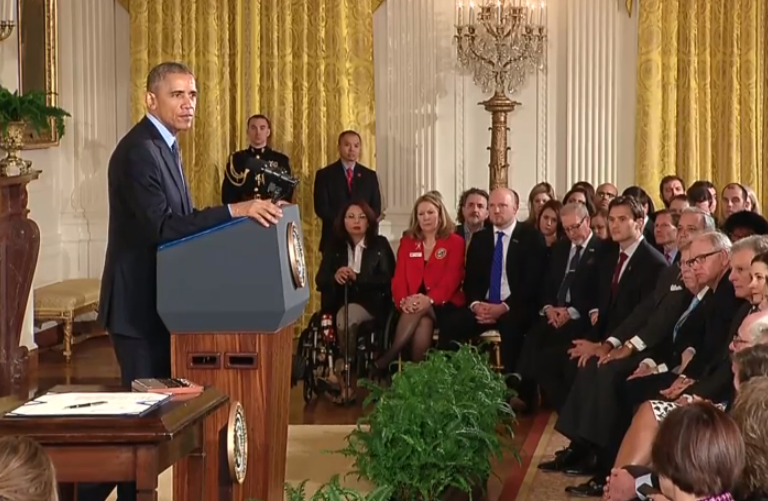
WASHINGTON – Congressman Tim Huelskamp (KS-01) will join President Barack Obama and other members of Congress at the White house for the signing ceremony of The Clay Hunt Suicide Prevention for American Veterans Act. The bill was passed by the House and the Senate without a single nay vote. A replay of the Thursday afternoon signing can be seen here (advance the video to the 18:20 mark)
“We all agree our Veterans deserve our support. Without a single nay vote, Congress and the White House have approved of a measure to address the staggering 22 veteran suicides per day. War often inflicts unseen battle scars our brave men and women then carry home with them and without professional help, these injuries often tear apart marriages and families. I am honored to join my colleagues today to commit to providing better mental health care to our Veterans when they return from the battlefield.
“I would take this opportunity to stress the need for continued accountability for those in management roles in the VA. We must improve the VA as a whole, while striving to increase Veterans’ choices for where and how they access the mental health care they