We have a brand new updated website! Click here to check it out!

National organization awarded grant to fight poverty in Kansas

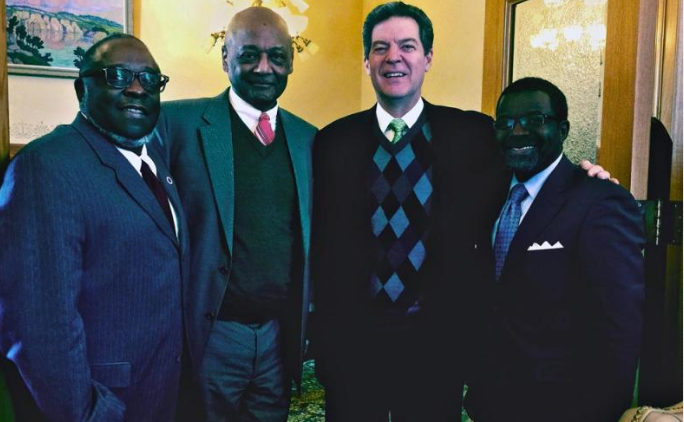
Photo by Kansas Department for Children and Families Gov. Sam Brownback, second from right, recently joined Center for Neighborhood Enterprise officials, from left, Charles Perry, Robert Woodson Sr. and Terence Mathis at the state’s announcement of a new initiative to address poverty-related community issues.

By DAVE RANNEY

Gov. Sam Brownback’s administration has awarded a one-year, $314,000 grant to a Washington, D.C.-based organization, the Center for Neighborhood Enterprise, to help low-income communities find ways to combat poverty, violence, substance abuse and absent fathers. “I’m excited to see this nationally recognized, successful initiative come to Kansas,” Brownback said in a recent Kansas Department for Children and Families news release of the national organization led by Robert L. Woodson Sr.

“Government doesn’t have the answers, our citizens know the problems plaguing their communities,” Brownback said, “and I look forward to working with Mr. Woodson to help our towns and neighborhoods grow at a grassroots level.” The Center for Neighborhood Enterprise is known for helping often-unrecognized leaders find ways to improve their communities without being overly dependent on government programs.

According to the grant, DCF and Center for Neighborhood Enterprise officials will recruit, train and assist 240 leaders from 17 cities: Dodge City, Fort Scott, Great Bend, Garden City, Hays, Hutchinson, Independence, Kansas City, Lawrence, Leavenworth, Liberal, Manhattan, Olathe, Pittsburg, Salina, Topeka and Wichita. Leaders in each community will be encouraged to “draft ideas” for addressing local needs.

Afterward, their proposals may be eligible for additional funding through public or private grant programs. The groups are expected to include people involved in law enforcement, child welfare, health care, mental health, social services, city government, credit counseling and the local faith community.

The initial meetings are expected to start in March. Theresa Freed, a DCF spokesperson, said the grant is underwritten with State General Fund monies in the department’s budget for the current fiscal year. The grant, awarded in November, was not subject to legislative approval.

The Center for Neighborhood Enterprise was founded in 1981 by Woodson, a former National Urban League administrator. According to the Center for Neighborhood Enterprise website, Woodson, now 77, “is the only person ever to have received both the liberal and conservative world’s most prestigious awards — the John D. and Catherine T. MacArthur ‘Genius’ Fellowship and the Lynde and Harry Bradley Foundation Prize, as well as the Presidential Citizens Medal.”

Woodson has agreed to spend up to 208 hours on the Kansas project. A Wall Street Journal article last year described Woodson as a “no-nonsense black conservative” who’s known for taking a market-driven — rather than government-dependent — approach to fighting poverty. In an interview Wednesday with KHI News Service, Woodson said most anti-poverty programs go into troubled communities “looking for deficiencies — families with kids who’ve dropped out of school, are in jail or on drugs.” The Center for Neighborhood Enterprise, he said, takes a different approach.

“When we go in, we look at the 30 percent of the homes without those deficiencies,” he said. “We identify their strengths, and then we look for what can be done to build on those strengths.” Oftentimes, he said, the strengths can be developed by using resources within the private sector rather than relying on government-funded support.

“The reason the word ‘enterprise’ is in our name is because we believe the principles that apply in a market economy also should apply in a social economy,” Woodson said. Barry Feaker, executive director at the Topeka Rescue Mission, said he’s not familiar with the Center for Neighborhood Enterprise. “What they’re wanting to do sounds like what we’re doing with Hi-Crest here in Topeka,”

Feaker said, referring to one of the most poverty-stricken neighborhoods in the nation. “It’s all about empowering people within their own neighborhoods.” Feaker said he’s been “more than encouraged” by the rescue mission’s successes in reaching out to Hi-Crest residents. “Crime is down,” he said.

“There’s a renewed interest in the community; residents have latched on to some hope in what they can do. City government is more involved, the private sector is more involved. There’s housing rehabilitation going on that wasn’t going on before. There’s a lot more interaction between the mental health and substance abuse programs. There’s been an explosion in interest from church groups. There’s significant momentum going forward.”

Feaker said he would welcome the Center for Neighborhood Enterprise effort in Topeka. “We don’t have all the answers,” he said. “If they can come in and generate some substantive ideas on where to go from here, I’m all for that. Time will tell, I guess.”

Dave Ranney is a reporter for Heartland Health Monitor, a news collaboration focusing on health issues and their impact in Missouri and Kansas.

Kansas Senate votes to allow concealed guns without permit

concealed carryTOPEKA, Kan. (AP) — The Kansas Senate has approved a bill to allow people to carry concealed guns without requiring them to get a state permit or take training classes.
The vote Thursday was 31-7 and sends the measure to the House.

The bill is sponsored by 26 of the chamber’s 40 members, led by Majority Leader Terry Bruce.

A state concealed carry permit costs $132.50, and a person must undergo eight hours of training to get one.
Gun-rights groups note Kansas has long allowed the open carrying of weapons without a state permit. The bill’s critics say training should be mandated for people carrying concealed weapons.
The National Rifle Association says Alaska, Arizona, Vermont and Wyoming don’t require permits to carry concealed anywhere in the state.

Kansas House to vote on bill reducing marijuana sentences

Rep. Steve Brunk
Rep. Steve Brunk

TOPEKA, Kan. (AP) — The Kansas House is considering reducing sentences for the first two marijuana possession offenses.

The full chamber will consider the bill Thursday. It would make it unlikely that an offender would face prison time until their third marijuana conviction.

Supporters have said that the bill would divert more marijuana offenders to treatment and would save money and space in the state’s prisons. Kansas prisons are already overcrowded and are expected to stretch to 107 percent capacity by 2024.

Republican Rep. Steve Brunk of Wichita said in a party caucus meeting Thursday that he opposed the bill because it would move the state closer to marijuana decriminalization.

He said the move would be inconsistent with parallel measures to stiffen prison time for some offenses.

Kansas House passes teacher collective bargaining compromise

Rep. Sue Boldra
Rep. Sue Boldra

TOPEKA, Kan. (AP) — The Kansas House has approved a collective bargaining compromise between teachers and school boards.

The House passed the compromise bill 109-14 Thursday.

School boards and teachers unions can currently bring dozens of issues to the negotiating table, which critics say leads to deadlock.

The compromise bill would allow each side of the negotiations to bring five issues that would have to be addressed in addition to pay.

The bill’s language came as the result of an extensive amendment proposed by Republican Rep. Sue Boldra of Hays Wednesday that gutted its original provisions.

The original bill would have allowed non-union teachers to negotiate individually for pay and benefits and school boards would not have been required to extend to them deals reached with the union.

Police: Criminal Threat Reported at Elementary School

rcpdMANHATTAN- Police in Manhattan are investigating a report of possible criminal threat at Marlatt Elementary School.

The Riley County Police Department reported they received a call of a ‘Criminal Threat’ just after 5:30 p.m. on Wednesday at the school.

Officer Matthew Droge of the Riley County Police Department said, “Vaguely worded comments were received by USD 383 school officials in the 2700 block of Hobbs Drive.

There were no specific threats made to the school or staff.”

Joel T. Dugan demonstration rescheduled at the Shafer Gallery

shafer galleryDue to the potential for winter weather the demonstration by and reception for Joel T. Dugan in the Shafer Gallery scheduled for February 27 has been postponed until March 6.  The new times for the portrait paintings demonstration are Friday March 6 from 2 p.m. till 4 p.m. The reception will be held March 6 from 6 p.m. till 8 p.m. Dugan will be explaining the story he is telling in the cycle of narrative images and also the symbolism to be found there.

Kansas man arrested for sexual assault

Widler
Widler


SALINA – Police in Salina have arrested a man for an alleged sexual assault on another man.

Scott D. Widler, 47, Abilene, was arrested Wednesday on requested charges of sexual battery and aggravated criminal sodomy.

Police began their investigation on February 13th when the victim, in his 30s, was being treated at the hospital for injuries received during the incident.

Police say Widler and the victim are acquaintances.

Barton Nursing partnership with St. Rose Health Center continues to thrive

cte_nursing_media-1
Nursing students pose with one of the new Omnicell units in one of the new dedicated labs. The large piece of equipment is like a large vending machine for medicine that has to be opened in specific ways dictated by security measures.

Nothing can prepare a student for a career like hands-on experience with real-world equipment.  Barton’s Nursing, Adult Healthcare and Pharmacy Technician programs will all have more opportunities for continued real-world scenarios with the help of a recent, sizable donation of about $140,000 worth of equipment from St. Rose Health Center in Great Bend.

St. Rose has gone through several transitions over the past few years that made some of its equipment available to donate.

Barton’s Director of Nursing and Healthcare Education Kathy Kottas said the donation will be a huge benefit to her students.

“This is just huge for us,” she said.  “Even if we were to request this equipment, it would take us years to acquire it all and some of these pieces we could never even ask for.  It has just put us ahead leaps and bounds.”

Two Omnicell machines, which were two of the largest pieces physically, also carried the largest price tag of about $40,000 each.  The machines are found in almost all hospitals and are used to dispense medicine.

Kottas said experience with equipment is invaluable to students.

“They (medicine dispensing units) are in every facility that we go to, and they are big units and the thought of accessing them is pretty overwhelming for them at times,” she said.  “It’s similar to any other piece of equipment.  If they can get their hands on it here on our campus, where it’s safe and if they make a mistake it’s not going to be an issue, when they have to use one in real life, they’ve at least touched it and accessed it and it makes it less nerve-wracking or scary for them.”

The Omnicell units, in addition to the other items donated, contributed to a larger opportunity as a whole.  The materials allowed for the addition of a dedicated Pharmacy Tech lab for Pharmacy Tech students and an Adult Healthcare lab for Certified Nurses Aide and Certified Medical Aide students to get hands-on training.

“We were just getting limited with our facilities, and trying to find times for everybody to be able to use our existing nursing labs,” Kottas said.

In addition to increased space, the dedicated Adult Healthcare Lab, which includes a mock resident’s room, has helped meet regulations for instruction set forth by the Kansas Department of Aging and Disability Services.

One of the most meaningful pieces donated was not medical equipment.  It was a pew from the original chapel that resided in one of the iconic circular towers of St. Rose Hospital, which will eventually be demolished.

“It really is a symbol of our heritage,” Kottas said of the college’s longstanding partnership with St. Rose. “We have a lot of great partnerships with other institutions in the area, but this one is a little bit unique in that we have a bit of our nursing program’s history that connects us to them.”

Starting in 1966, the college teamed up with what was then known as the Dominican School of Nursing and decided a nursing curriculum would be established at Barton once it opened.  Sister Mary Ann Klein, who worked at the Dominican School of Nursing, became the first Director of Nursing at Barton and the relationship has grown from that first connection so many years ago.

St. Rose Administrator Leanne Irsik said the transitions at St. Rose will be helpful to Barton’s students as they continue their clinical work.

“Healthcare services are changing as we go forward and the opportunities for nursing students as they move into their careers are varied,” she said.   “Getting an opportunity to have an experience in a clinical environment that is not only a hospital environment, which will always be there, but the opportunity for them to work with patients in every environment that they can be cared for is critical because it is a totally different kind of relationship that they have with their patients in ambulatory setting and urgent care.”

The partnership continues to be vital to St. Rose as well.

“It is a critical partnership,” she said.  “It provides us the opportunity to help prepare the nurses of the future.”

For more information on the nursing program, call (620) 792-9357 or email kottask@bartonccc.edu.

Rosewood Aktion Club visits Shafer Gallery

Shafer Art Gallery Director Dave Barnes helps Rosewood Miracle Workers Aktion Club members identify pieces of artwork that they have been instructed to find at the Shafer Gallery, located at Barton Community College.  Rosewood’s Aktion Club toured the Shafer Gallery on Feb. 13. Pictured with Barnes (right to left) are Rosewood’s Dawn Specht and Ruth Ann Campbell. Rosewood Aktion Club is an affiliate of the national Kiwanis organization that promotes service in action for people with developmental disabilities. There are 12,000 members worldwide. The local club allows Rosewood clients to be actively involved in the community and to positively impact the lives of others.
Shafer Art Gallery Director Dave Barnes helps Rosewood Miracle Workers Aktion Club members identify pieces of artwork that they have been instructed to find at the Shafer Gallery, located at Barton Community College. Rosewood’s Aktion Club toured the Shafer Gallery on Feb. 13. Pictured with Barnes (right to left) are Rosewood’s Dawn Specht and Ruth Ann Campbell.
Rosewood Aktion Club is an affiliate of the national Kiwanis organization that promotes service in action for people with developmental disabilities. There are 12,000 members worldwide. The local club allows Rosewood clients to be actively involved in the community and to positively impact the lives of others.


C&V Home Improvement sponsors lead safe certification training

CV-WebLogoIn 2010, Kansas enacted legislation requiring contractors and landlords to follow Lead Safe Work Practices (LSWP) when remodeling homes and certain commercial entities built prior to 1978. Contractors and landlords must assume lead is present in paint and stains for all pre-78 homes.

Contractors are required to complete certification and to conduct their work in compliance with the LSWP. One struggle facing certification for contactors is the lack of local certification classes. The closest available training is in the Wichita area.

“We are sponsoring this class so that all contractors and landlords can have convenient access to certification and recertification.” said Matt Hoisington, owner of C&V.

According to the EPA’s booklet, The Lead-Safe Certified Guide to Renovate Right, “Lead can affect Children’s brains and developing nervous systems, causing reduced IQ, learning disabilities and behavioral problems. Lead is also harmful to adults.”

While licensed contractors perform a lot of the remodeling projects, landlords commonly do work on their rentals. They, too, need to be certified.

Hoisington said, “We are very committed keeping our customers and their family safe while we are working in their homes. We are a Lead Safe Renovation Firm and all of our installers are state certified. Our job is to educate the homeowners or tenants on the dangers of lead and to perform our work in a manner that protects them.”

The real danger is creating dust. Windows and doors have moving parts. As such, they are especially prone to creating airborne lead, via dust that is disturbed during replacement.

“As a Lead Safe firm, we contain the work area using zip walls, minimize the dangerous dust created during projects and we clean up using a heppa vac. We also document our work site practices with photographs.”

Hoisington further noted, “Many local contractors are not Lead Safe Certified. Some chose to ignore the law and put their customers in danger. Others report that they simply can’t afford to send their employees to Wichita for certification. We hope that by bringing this training to Great Bend, all contractors will get certified.”

Many contractors completed certification pursuant to the 2010 law. However, certification must be renewed every 5 years. Recertification ($100) will be held on Monday, March 16, from 1:00-5:00 at KansasWorks, 1107 Main Street, Great Bend. For those needing the initial certification ($150), training will be held on Tuesday, March 17, from 8:00-5:00 at the Front Door, 1615 10th Street, Great Bend.

Kansas Department of Health and Environment officials will be on hand to answer questions during the training.

“Last fall, KDHE staff attended a recertification class I took. It was really beneficial to speak directly with them. KDHE is not out to bust contractors; but rather to educate them on the dangers of lead dust and help them complete remodeling projects in a safe manner.” said Hoisington.

Class size is limited to 20 participants. To sign up, contact Matt Hoisington at 620-617-5500 or by email at Matt@CVHIpros.com.

Copyright Eagle Radio | FCC Public Files | EEO Public File