LANSING, Kan. (AP) — The adopted daughter of a retired Army officer living in northeastern Kansas may soon be sent back to South Korea.
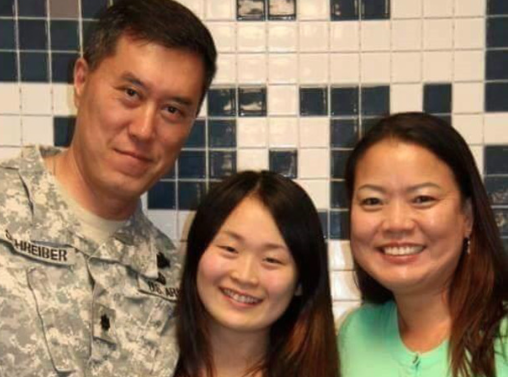
Patrick Schreiber, wife and daughter-courtesy photo
On Friday, a federal judge in Kansas ruled in favor of U.S. Citizenship and Immigration Services, which seeks to deport Hyebin Schreiber, the legally adopted daughter of retired Lt. Col. Patrick Schreiber of Lansing.
Schreiber sued after immigration authorities rejected visa and citizenship applications for Hyebin. The woman had been Schreiber’s niece when he and his wife legally brought the then-15-year-old girl to the U.S. in 2012.
Schreiber’s deployment the following year to Afghanistan and bad legal advice led the couple to put off her legal adoption until she was 17. But under immigration law, foreign-born children must be adopted before reaching 16 to derive citizenship from their American parents.
Schreiber, who has served six overseas tours in a 27-year U.S. military career, has said he and his wife would go to South Korea with their daughter if she’s deported.
Kansas wheat farmers have a unique opportunity to export wheat into African and Asian markets. Unfortunately for Australian wheat farmers, their crop has been plagued by drought and freeze. They won’t be able to meet the export demand for the white wheat they grow. This gives Kansas wheat farmers the chance to meet this international demand. Planting decisions made now will affect the supply that is available over the next year, while Australia’s exports lag.
While in Lagos, Nigeria, the 2018 Sub-Saharan Africa Board Team met with executives at Flour Mills of Nigeria at the company’s mill in Apapa area of Lagos.
Jay Armstrong, a Kansas wheat farmer who serves on the Kansas Wheat Commission and recently returned from a trade mission to Nigeria and South Africa, says wheat buyers in Sub-Saharan Africa are looking to the U.S. to help fill this void. The 2018 Sub-Saharan Africa Board Team trip was sponsored by U.S. Wheat Associates, the U.S. wheat industry’s export market development organization.
Australia is the only competitor to the U.S. in the hard white wheat market. Australia recently lowered its production forecast by nearly 13 percent, cutting its exports to a 10-year low.
Countries such as Taiwan, Korea and Nigeria, who look to Australia to purchase the white wheat they need for their products, are looking to the U.S. to source hard white wheat in the wake of this forecast.
“Because Australia is not going to be able to meet demand for white wheat, buyers are coming to the U.S. for hard white wheat,” said Justin Gilpin, CEO of the Kansas Wheat Commission and Kansas Association of Wheat Growers. “We are, right now, in the beginning of a long window, where we can fill this demand by planting hard white wheat now for harvest next summer.”
Gilpin says this window continues through this marketing year and into next marketing year. Because of Australian production shortfalls, prices on Australian wheat are high.
“Farmers need to be considering hard white wheat as they are making planting decisions,” said Gilpin. “This demand will continue through next year’s harvest.”
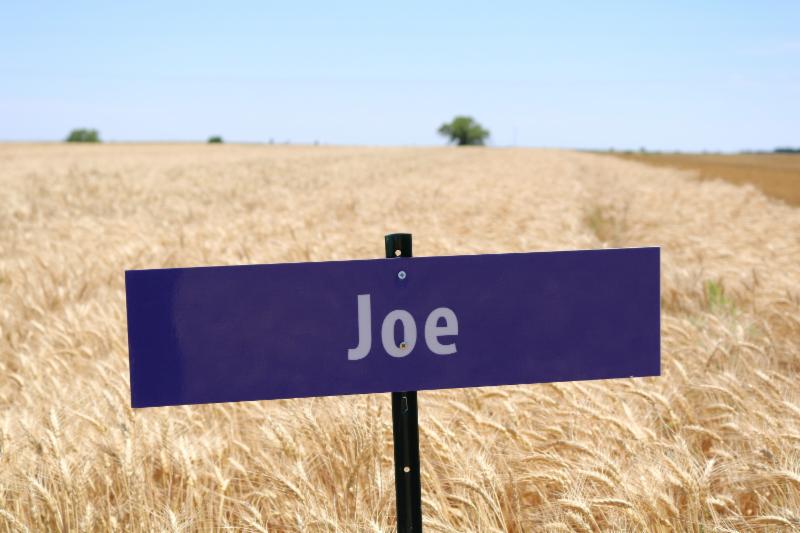
The variety Joe, which was developed by the K-State breeding program, has good milling quality and also carries a gene for resistance to Wheat Streak Mosaic Virus.
For farmers who are looking to plant hard white wheat this fall, there are a number of excellent varieties available. The variety Joe, which was developed by the K-State breeding program, has good milling quality and also carries a gene for resistance to Wheat Streak Mosaic Virus, which has caused wide-spread damage in western Kansas, where hard white wheat is best adapted.
The caution with planting hard white wheat remains what it has been for years – know where you will be delivering your wheat prior to planting. However, with hard white wheat acres increasing in recent years, more elevator locations are handling it at harvest time and beyond.
Eric Sperber, CEO of Cornerstone Ag in Colby, Kan., says they have sent many samples of hard white wheat to Nigeria for them to do bake tests and overall quality tests. The feedback has been positive.
“Because Australia is having problems, we are getting some of this business,” he said.
High Plains Platinum hard white wheat is being loaded in western Kansas to meet this demand. The High Plains Platinum brand represents a high set of quality standards for hard white winter wheat. Learn more at https://highplainsplatinum.com/.
With the feedback he received from his trip, Armstrong predicts, “We will have a higher demand than what we can grow.”
The Barton Community College volleyball team went 2-2 this weekend in Arkansas City, Kansas, taking on four NJCAA Division I ranked opponents in the Cowley Invitational.
Barton stands at 12-10 on the season, returning to conference play Monday in taking their fourth place 5-2 record to eighth place Dodge City Community College (1-8, 4-17) in a 6:30 p.m. first serve.
The Cougars started off sluggish in their 2:00 p.m. Friday match against 14th ranked Iowa Central Community College, digging a two set deficit by 25-22 and 25-18 scores before rallying with 28-26 and 25-17 victories to force a fifth set. Playing just their first deciding set of the season, the Cougars’ four point lead would not hold up as the Tritons battled back for the 15-13 win.
Two hours later the Cougars were back on the court against the highest ranked opponent of the Invitational, playing the host and nation’s No. 6 squad on their home court in the first day feature match. Winning the first two sets 25-21 and 25-23, the Cougars dropped the third 25-22 before taking control in overcoming a four point deficit to roll to a 25-20 victory.
Day two began with a sweep over nationally receiving votes Carl Sandburg College, winning identical 25-20 set scores before earning a hard fought 26-24 match clinching third.
Last on the weekend docket was No. 11 Northeastern Oklahoma A&M College as the Cougars again dug a 2-0 hole, grabbed the third set, but couldn’t keep the momentum into the fourth as the Norseman won the match 3-1 (25-14, 25-21, 21-25, and 25-14).
HAYS, Kan. – Fort Hays State posted its first shutout of an opponent since the 2008 season when it defeated Central Oklahoma on Saturday night (Sept. 29) by a score of 15-0. Dante Brown set a new FHSU single-game record for field goals, accounting for all 15 points on five converted attempts. The No. 18/13 ranked Tigers sent home a packed Lewis Field Homecoming crowd of 7,140 fans happy, especially with a fireworks show after the game.
The Tigers remain in a tie for second place in the MIAA with Northwest Missouri State at 4-1 overall. Central Oklahoma dropped to 2-3 on the season. Pittsburg State continues to lead the MIAA, now at 5-0 overall. The Tigers go to Emporia State next Saturday (Oct. 6), looking to keep pace in the standings with the frontrunners, before returning home on October 13 to face Pittsburg State.
MANHATTAN, Kan. (AP) — Sam Ehlinger threw for 207 yards and a touchdown, D’Shawn Jamison returned a punt 90 yards for another score and No. 18 Texas held off Kansas State 19-14 to snap a five-game road losing streak to the Wildcats. Texas led 19-0 at halftime before hanging on in the second half, when the Wildcats went to backup quarterback Skylar Thompson.
FORT WORTH, Texas (AP) — Jonathan Song kicked a 28-yard field goal with 37 seconds remaining and TCU beat Iowa State 17-14. The game-deciding kick came three plays after TCU quarterback Shawn Robinson was helped off the field and taken directly to the locker room after taking a hard hit to his left shoulder at the end of a 1-yard run to the 10.
KANSAS CITY, Mo. (AP) — Adalberto Mondesi hit a tiebreaking, three-run homer to lift the Kansas City Royals to a 9-4 win over the Cleveleand Indians. Corey Kluber gave up three runs and seven hits in five innings in his final regular season start for Cleveland. Working with a short pitch count in his tune-up for American League Division Series against Houston, Kluber struck out six while throwing 80 pitches. Indians catcher Yan Gomes left the game in the bottom of the third with an injured right hand.
CHICAGO (AP) — The Chicago Cubs lost 2-1 to the St. Louis Cardinals, sending the NL Central race to the final day of the season. The Cardinals kept alive their hope for a wild card, but were eliminated by the Los Angeles Dodgers’ 10-6 victory at San Francisco.
LAWRENCE, Kan. (AP) — After last week’s 24-point loss to Texas Tech that knocked them out of the top 25, Oklahoma State came to Kansas needing a big win. Almost right away, you could tell that wouldn’t be a difficult goal. Taylor Cornelius passed for 312 yards and four touchdowns, Justice Hill ran for 189 yards and the Cowboys (4-1, 1-1 Big 12) cruised to a 48-28 win over the Jayhawks (2-3, 0-2 Big 12).
National Headlines
UNDATED (AP) — The Chicago Cubs and Milwaukee Brewers are all tied for first place in the NL Central heading into the final game of the regular season. Miles Mikolas (MY’-koh-lahs) improved to 18-4 by limiting the Cubs to an unearned run and five hits over eight innings of the St. Louis Cardinals’ 2-1 victory at Wrigley Field. Christian Yelich (YEH’-lihch) homered twice, including a tiebreaking solo shot in the seventh inning to push the Brewers past Detroit, 6-5.
UNDATED (AP) — The Los Angeles Dodgers were able to clinch the final major league playoff berth and move into a first-place tie with Colorado in the NL West by outscoring the Giants, 10-6 in San Francisco. Manny Machado tripled home the tiebreaking run in the eighth for the Dodgers, who also benefited from home runs by Joc Pederson and Yasiel Puig (YAH’-see-ul pweeg). The Washington Nationals played the spoiler’s role to perfection in Denver as Juan Soto provided a solo homer and four RBIs in a 12-2 thrashing of the Rockies.
CLEMSON, S.C. (AP) — Third-ranked Clemson survived a scare as Travis Etienne capped his career-high 203-yard rushing performance by scoring the go-ahead touchdown from two yards out with 41 seconds left in the Tigers’ 27-23 triumph over Syracuse. Things looked bleak for the Tigers when Eric Dungey’s second 1-yard rushing TD put Syracuse up 23-13 with less than 13 minutes left. But backup QR Chase Brice guided a 94-yard fourth-quarter drive that ended with Etienne’s third touchdown of the afternoon.
UNDATED (AP) — Freshman Jaylen Waddle returned a punt for a touchdown and caught two scoring passes, including a 94-yarder, in No. 1 Alabama’s 56-14 victory over Louisiana-Lafayette. D’Andre Swift ran for two touchdowns and second-ranked Georgia used dominant defense to overcome a sluggish offensive start in a 38-12 win over Tennessee. Dwayne Haskins threw two touchdown passes in the final seven minutes to wipe out fourth-ranked Ohio State’s 12-point deficit in a 27-26 triumph at No. 9 Penn State.
SAINT-QUENTIN-EN-YVELINES, France (AP) — Europe is carrying a 10-6 lead over the United States into the final day of Ryder Cup. Just two teams have come back from such a deficit: the Americans at Brookline in 1999 and the Europeans in the 2012 “Miracle at Medinah.” Europe led 10-4 Saturday until Bubba Watson and Webb Simpson defeated Sergio Garcia and Alex Noren 3 and 2, while Jordan Spieth and Justin Thomas bounced back from an early deficit to take a 4-and-3 victory over Rory McIlroy and Ian Poulter.
Saturday Scores
INTERLEAGUE
Final Milwaukee 6 Detroit 5
AMERICAN LEAGUE
Final N-Y Yankees 8 Boston 5
Final Houston 4 Baltimore 3
Final Tampa Bay 4 Toronto 3
Final Minnesota 8 Chi White Sox 3
Final Kansas City 9 Cleveland 4
Final Houston 5 Baltimore 2
Final Oakland 5 L-A Angels 2
Final Seattle 4 Texas 1
NATIONAL LEAGUE
Final St. Louis 2 Chi Cubs 1
Final L-A Dodgers 10 San Francisco 6
Final Cincinnati 3 Pittsburgh 0
Final Philadelphia 3 Atlanta 0
Final N-Y Mets 1 Miami 0, 13 Innings
Final Washington 12 Colorado 2
Final Arizona 5 San Diego 4
TOP-25 COLLEGE FOOTBALL
Final (1) Alabama 56 Louisiana-Lafayette 14
Final (2) Georgia 38 Tennessee 12
Final (3) Clemson 27 Syracuse 23
Final (4) Ohio St. 27 (9) Penn St. 26
Final (5) LSU 45 Mississippi 16
Final (6) Oklahoma 66 Baylor 33
Final (8) Notre Dame 38 (7) Stanford 17
Final (10) Auburn 24 Southern Miss 13
Final (11) Washington 35 (20) BYU 7
Final (12) West Virginia 42 (25) Texas Tech 34
Final (13) UCF 45 Pittsburgh 14
Final (14) Michigan 20 Northwestern 17
Final (17) Kentucky 24 South Carolina 10
Final (18) Texas 19 Kansas St. 14
Final (19) Oregon 42 (24) California 24
Final (21) Michigan St. 31 Cent. Michigan 20
Final Virginia Tech 31 (22) Duke 14
Final Florida 13 (23) Mississippi St. 6
MANHATTAN, Kan. (AP) — Texas coach Tom Herman talked with one of his predecessors, Mack Brown, just as he does every week, and the old Longhorns coach warned him about playing Kansas State in Manhattan.
They’re a different team on the road, Brown said. They play with more energy, channeling the will of the crowd, and the team that was trounced by West Virginia last week wouldn’t show up Saturday.
“It was very much the way we told our players it would be,” Herman said.
The No. 18 Longhorns roared to a big lead, bogged down in the second half, then held on through a tense fourth quarter for a 19-14 victory that snapped a five-game road skid against the Wildcats.
“We won ugly, but the key is we won,” Herman said. “They all look pretty on Sunday morning.”
Sam Ehlinger threw for 207 yards and a touchdown, and D’Shawn Jamison returned a punt 90 yards for another score, as the Longhorns opened a 19-0 lead by halftime. Then, Keaontay Ingram churned for a first down with three minutes to go to help the Longhorns (4-1, 2-0 Big 12) seal the win.
“It shows our maturity, being able to overcome a lull in what’s going on,” Ehlinger said. “A lot of offenses would have curled up but we chose to finish.”
Skylar Thompson threw for 96 yards in relief of ineffective quarterback Alex Delton, and he led the Wildcats (2-3, 0-2) to a pair of touchdowns in the second half. But after they got the ball back with 7:12 to go, Thompson threw a pair of incompletions as Kansas State went three-and-out, and coach Bill Snyder’s offense never got another opportunity with the ball.
“All losses are painful. There is a variety of different reasons why didn’t win the ballgame,” Snyder said. “I think we became a little better football team, not necessarily because of this game but because of the way we practiced last week.”
The Longhorns leaned on their defense in the opening half, getting a pair of sacks by Charles Omenihu — one for a safety — while shutting down Kansas State’s powerful run game.
Meanwhile, the Wildcats’ dismal half was summarized by the way it ended, when they had first-and-goal at the Texas 5. Alex Barnes was stuffed, and two runs by Delton went nowhere, before his pass on the final play hit fullback Adam Harter in the hands and dropped incomplete.
The result? Texas carried its 19-0 lead into the break.
The Longhorns were so stingy on defense — and Kansas State so inept on offense — that running back Tre Watson had more yards passing after a 21-yard halfback pass than the entire Wildcats roster in the first half. Delton was 3 of 7 for 14 yards.
In fact, Texas had more yardage in penalties (80) than Kansas State had on offense (64).
The Wildcats switched quarterbacks at halftime and Thompson promptly led them 82 yards on their opening possession, capping the drive by keeping it on third-and-goal for a 7-yard touchdown run.
Suddenly, that herky-jerky offense had found its rhythm.
Texas kicker missed an opportunity to extend the lead when he pushed a 47-yard field goal right, and Kansas State marched downfield again. Thompson hit Dalton Schoen to convert one fourth down, and Barnes plowed in on fourth-and-goal from the Texas 1 to make it 19-14 with 9:55 to go.
“We rallied together as a team and came out with a different mentality than we did in the first half,” Kansas State linebacker Justin Hughes said.
But after forcing Texas to punt, the Wildcats went three-and-out and the Longhorns got the ball back. They managed to convert on third-and-11 before getting another first down to ice the win.
“When you look at our record,” Herman said, “you’re not going to see half a ‘W’ for this. They all count the same, and we told our guys, ‘Championships are won on the road.'”
BECK’S STATUS
Herman said that offensive coordinator Tim Beck was recovering after being hospitalized for a bacterial infection in his elbow and should rejoin the team soon. “He had to be on IV antibiotics and had surgery Thursday to clean all that infection out,” Herman said. “That’s a lesson for all of us, you have one of those nagging deals, you should get it looked at.”
STATS AND STREAKS
Ehlinger now has nine touchdown passes and just two interceptions this season. … Texas had not won in Manhattan since 2002. … Barnes finished with 80 yards rushing for Kansas State. … The Wildcats’ Isaiah Zuber had five catches for just 33 yards. He was coming off back-to-back 100-yard receiving games. … Texas was flagged for 104 yards in penalties.
POLL IMPLICATIONS
The march up the rankings will likely continue for the Longhorns, who have followed their season-opening loss to Maryland with their longest win streak since the 2013 season.
LAWRENCE, Kan. (AP) — After last week’s 24-point loss to Texas Tech that knocked them out of the top 25, Oklahoma State came to Kansas on Saturday needing a big win. Almost right away, you could tell that wouldn’t be a difficult goal.
Taylor Cornelius passed for 312 yards and four touchdowns, Justice Hill ran for 189 yards and the Cowboys (4-1, 1-1 Big 12) cruised to a 48-28 win over the Jayhawks (2-3, 0-2 Big 12).
Oklahoma State found the end zone on each of its first three possessions and scored on their first four, setting the tone early.
“I was proud of how our guys started the game,” coach Mike Gundy said. “Sometimes we’ve not played real good up here in the first half. I thought our defense and offense really took the field and motivated themselves and played well early in the game, which was very important.”
Kansas’ defense was simply no match.
“They had a really good gameplan, and they executed it,” coach David Beaty said. “That was the key.”
Cornelius got things going early, throwing to Tylan Wallace on a slant route for the 11-yard touchdown before hitting Landon Wolf for a 42-yard score on a deep ball the next drive.
Cornelius’ first incompletion didn’t come until the third drive, when he overthrew a wide-open Braydon Johnson streaking down the field. Kansas would not learn from that lucky break, though, as Tyron Johnson got open on almost an identical route on the next play on his way to a 64-yard score.
“It was just something we worked on all week, those shot plays,” Cornelius said. “Missed Braydon on the first one, then we were confident enough to come back with a different little scheme the next time. Tyron did a great job getting open. Just made the throw that time.”
Hill was a steady counterweight to the passing game, averaging 6.1 yards per carry on 31 rushes. He scored in the third quarter, running in from 10 yards out after a pair of big passes got the Cowboys in the red zone.
“Our plan going in was to let him carry the load, and it worked out well for us,” Gundy said. “He made the extra guy miss several times. We’re lucky to have a guy special enough to do that.”
Kansas turned to Carter Stanley for his first start under center all year, benching Peyton Bender who had previously started all four games. Stanley responded well, throwing for 247 yards on 24-of-32 passing and three touchdowns.
“I was definitely happy to be out there, no doubt,” Stanley said. “Felt good. But me personally, I know I can — on some simple stuff, some simple stuff that may not seem like a big deal — I know I can be a lot better in certain situations.”
True freshman Pooka Williams shined once again, picking up 97 yards rushing and 60 yards in the passing game. This included a 60-yard ground burst for a score in the Jayhawks’ first drive of the second half, his fourth touchdown on the year.
MISSING MILES
Kansas quarterback Miles Kendrick did not play after sustaining a shoulder injury last week against Baylor. Kendrick had been in a timeshare with the now-replaced Peyton Bender all season, but seemed to be earning a larger role after playing the entire second half in Week 3 before going down.
PENALTY PROBLEMS
Oklahoma State finished with 92 penalty yards to Kansas’ 43. There were multiple instances in which the Jayhawks got significant help from the Cowboys’ mistakes, most noticeably in the passing game.
“Eight penalties for 92 yards, that’s crazy,” Gundy said. “We gave up a plus-40 in the penalty (margin). So way too many penalties, off a couple offensive pass interferences. But we’ve got to improve in that area.”
WOLF’S WELCOMING
Wolf entered the game with just four catches on the year for 41 yards, all coming in Oklahoma State’s first two games against lesser competition. As a two-year walk-on put on scholarship before this season, his role in the offense seemed firmly limited.
But when Jalen McCleskey announced his plans to redshirt and transfer, opportunity arose for Wolf. He wouldn’t let that go to waste, finishing with 116 yards on six catches including the 42-yard score.
“That dude, he stepped up today,” Cornelius said. “He played good. He knows how to get open, he runs good routes. I’m so happy for him.”
THE TAKEAWAY
Oklahoma State grabs a much-needed first Big 12 win after taking a drubbing last week at the hands of Texas Tech. Big victories like these will help the Cowboys make it back into the Top 25.
Kansas slides to 2-3 and 0-2 in the Big 12. After a promising start to the year, one has to think Beaty’s leash is growing shorter with every loss.
UP NEXT
Oklahoma State returns home to face Iowa State on Saturday.
Kansas hits the road Saturday to take on No. 12 West Virginia.
Angie Schreiber sees it time and again: dyslexic students failing to learn to read through traditional teaching techniques.
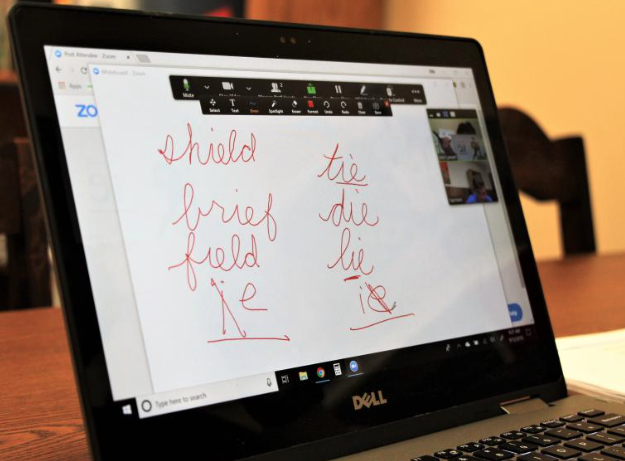
A computer screen shows some of the tricky spelling rules that Ann Lawyer, a teacher at Cradle to Career Literacy Center in Emporia, shared with one of her students during a recent online lesson. CELIA LLOPIS-JEPSEN / KANSAS NEWS SERVICE
But she says she knows how they can flourish.
Schreiber’s private teaching service in Emporia uses an approach known as structured literacy. The method drills students on myriad rules of English sound and spelling that most of us never learned consciously.
On a recent Wednesday, one of her instructors fired up a laptop for a lesson with Harrison Leniton, an eighth-grader in the southeast Kansas school district of West Elk.
“If I have the ‘kuh‘ sound,” special education teacher Ann Lawyer asked him through their remote video connection, “and I’m using that with an A, O, U — or another consonant — what do I use?”
Harrison: “C.”
Lawyer: “Excellent.”
West Elk eighth-grader Harrison Leniton reviews advanced phonics rules with his teacher, Ann Lawyer.
CREDIT CELIA LLOPIS-JEPSEN KANSAS NEWS SERVICE
For years, dozens of parents of children with dyslexia have gone to the Kansas Legislature with stories of students who don’t get what they need in school — or get it years late, when catching up is many times harder.
Many want the type of lessons Harrison receives.
Now, a state task force could make that happen — with potential, and controversial, effects for how schools teach all children to read.
Skeptics of that structured literacy approach watch uneasily. The state’s colleges of education — where proponents of a different kind of instruction dominate — barely show up on the roster for the task force that could determine the next generation of reading instruction in the state.
Ken Weaver, dean of the Teacher’s College at Emporia State University, says literacy professors were left out by design.
“That is a purposeful mistake,” he said, “to ensure that that voice is not heard.”
Rote rules and reading
The structured literacy classes that Harrison takes can feel like “i before e except after c” for grad students.
Harrison spent the past year catching up multiple grade levels in reading. To do that, he memorized many explicit guides to the maddening world of English orthography. His lessons are peppered with advanced phonics terms. Digraph. Diphthong. Dieresis.
“We take them back to the beginning and say, what we need is to show you a different way to learn to read and spell,” Schreiber said.
Emporia-based teacher Ann Lawyer counts as her student, Harrison Leniton, parses out individual phonemes, or sounds, in a list of words.
CREDIT CELIA LLOPIS-JEPSEN /KANSAS NEWS SERVICE
Many children fret when they fall behind their classmates, even though studies show students with dyslexia are as smart as their peers without it. When schools don’t offer structured literacy, its proponents say, reading drifts farther and farther out of reach. Children with dyslexia pay the price in anxiety, depression and higher dropout rates.
In the past six years alone, American Public Mediasays, more than 30 states have passed laws meant to address concerns that children with dyslexia don’t get help, or even diagnosed.
Some of those laws require teachers colleges to teach structured literacy or the basics of dyslexia. Others make schools screen for the disability and offer intensive phonics. Still others mandate annual dyslexia training for educators.
Kansas doesn’t have any such state law or regulation — yet.
The reading gap
A staggering number of students in the U.S. struggle with reading, whether they’ve been diagnosed with dyslexia or not.
In Kansas, more than half aren’t likely to be able to handle college-level complexity by the time they finish high school. More than a quarter are so far behind they’re not even reading at grade level.
Poor academic outcomes often get attributed to demographic factors, such as poverty. But dyslexia researchers argue the disability — and the way it often goes untreated — likely contributes to a large chunk of the problem.
“The nation has to recognize this is one of the major things holding back millions of children,” said Sally Shaywitz, a professor of pediatrics at Yale University.
The co-founder of the Yale Center for Dyslexia and Creativity, she says one in five people has dyslexia. That translates to a handful of children in any given classroom — a strong argument for training teachers and screening students.
But other sources peg the prevalence of dyslexia at possibly fewer than one in 20. Those figures have some educators concerned that a national movement of vocal parents is pushing schools to overdiagnose children, or focus too much on what is just one of a wide range of student issues that teachers juggle, from childhood trauma to autism.
More phonics?
Then there’s the second big rift that makes conversations between parents and schools difficult: The fight over how children best learn to read.
Literacy specialists at colleges of education today largely push balanced literacy, an approach that relies more on learning through context and deduction, less on detailed lessons in sounds and orthography.
Dyslexia advocates say decades of well-settled research shows that being more explicit benefits all children, not just those with dyslexia. They say it could mitigate the nation’s literacy problems.
The International Literacy Association and International Dyslexia Association have sparred over the matter. (Read their arguments here and here.)
Annie Opat, a literacy expert at Emporia State, said she attended some of the teacher training that structured literacy advocates favor. She wasn’t impressed. Rather, Opat worries that drilling students takes away the enjoyment and context that stimulate learning.
“They’re learning this letter and it’s not related to meaning,” she said. “So that, to me, is not the optimal way for the brain to take on new learning.”
Instead, Opat said, children need to see significance in what they learn.
“If you’re going to learn the letter ‘A’ and my name is ‘Annie,’ that ‘A’ would mean something significant to me knowing it’s part of my name,” she said. “As human beings, if we enjoy something, we’re going to get better at it with more practice.”
That view rankles parents of children with dyslexia, who say context and interest aren’t enough to flip a switch in a brain that’s wired differently. The rules that some teachers dismiss as arcane and tedious can be the difference between whether or not a kid will ever make it through Seuss or Salinger.
Lori McMillan, a Topeka mother whose 8-year-old, Wyatt, has dyslexia, worried when he continued to struggle with basic words in first grade. She recalls writing “the” on a cue card and studying it with him at home.
“By the end of about 20 minutes, you know, he was picking it out of paragraphs,” she said. But 20 minutes later, after practicing the next word, “is,” McMillan showed Wyatt “the” again.
“It was like he’d never seen it before in his life.”
What finally worked for Wyatt, McMillan says, was the explicitness of structured literacy.
The building blocks
On a recent Monday, a few children learned one-on-one with the staff at Pittsburg State University’s Center for Research, Evaluation and Awareness of Dyslexia in southeast Kansas.
The center serves children from multiple states, like 8-year-old Dylan Brooks, of Missouri.
“‘King’ without ‘kuh,’” Courtney Hensler prompted Dylan. “Ing,” he replied. “‘Man’ without ‘mmm’?” she followed up. “An,” came his answer.
Structured literacy drills aim to stimulate sound awareness in children with dyslexia. Doing the mental calculation of deleting a word’s first sound requires an awareness that those individual sounds exist, and can be pulled apart that way.
But the brain pathways that make this connection don’t seem to function the same way in people with dyslexia, researchers say. Helping them hear and manipulate phonemes like “mm” and “kuh” are a first and crucial step to pulling the curtain back on symbols “M” and “K.”
“If you don’t understand that words are made up of sounds,” Pitt State psychology professor David Hurford said, “then when you get to the point where you’re decoding words, that makes no sense to you.”
Hurford leads his college’s dyslexia center and is the sole professor on Kansas’ new dyslexia task force, created by the Legislature last spring.
But academics who teach balanced literacy — the other side of the debate — aren’t convinced their approach is so lacking in the skill sets that Hurford says their colleges should teach.
“Phonemic awareness, sound-symbol associations, decoding,” said Debbie Mercer, dean of the Kansas State University College of Education. “Our program is very strong there. Our students take more coursework in reading methodology than anything else.”
Changes likely
Pitt State’s dyslexia center offers discounts for low-income families, but in other parts of the state, parents say they can’t find such options — if they can find dyslexia specialists at all. Private-practice specialists can cost hundreds of dollars a month.
The state’s dyslexia task force wants to address the lack of access through schools.
Dylan Brooks and his teacher, Courtney Hensler, take short breaks for fun during his after-school reading lessons. Here Dylan aims to hit a ball with a foam bat.
State board chairman Jim Porter, who also heads the task force, believes his colleagues there will be eager to act.
“There are students,” he said, “whose needs are not being met.”
But education groups wary of overregulation — and a proposal last spring to require dyslexia screening — told lawmakers that Kansas teacher colleges already prepare teachers to help struggling readers. Kansas classrooms, meanwhile, should already be monitoring children for academic deficits and giving stragglers extra help.
The state’s associations for school boards and special education administrators agreed.
But Harrison’s mother, Cynthia Leniton, says structured literacy classes changed her son’s outlook. Now, she says, he sees college as a possibility.
“The education system didn’t know what dyslexia really was,” she said, recalling how she moved him to a different school district in search of better help and signed him up for private lessons in structured literacy.
When it seemed to work, she showed his new superintendent the results and found him willing to offer the remote lessons at school.
The remote lessons cost about $2,500 per student per year. West Elk is now spending about $11,000 for three of its teachers to learn the technique.
The task force exploring whether to roll out dyslexia or structured literacy training on a broader scale hopes to calculate statewide cost estimates for doing so by January.
That could mean training not for three teachers, but for thousands.
Celia Llopis-Jepsen is a reporter for the Kansas News Service. You can reach her on Twitter @Celia_LJ.
ELLIS COUNTY —Cardinal Theodore E. McCarrick, 88, the former archbishop of Washington, D.C., who resigned July 27 from the College of Cardinals after allegations he had sexually abused minors and adult seminarians, will be residing at the St. Fidelis Friary in Victoria.
According to a news release from the Salina Catholic diocese, the Archdiocese of Washington, D.C. announced today that “Archbishop McCarrick will live a life of prayer and penance” and is “excluded from any public appearances and ministry.” The diocese of Salina is not incurring any costs during the arrangement.
McCarrick’s resignation was accepted July 28 by Pope Francis. McCarrick remains a priest pending the outcome of a Vatican trial.
Included in the news release is a letter from recently installed Salina diocese Bishop Gerald Vincke who explains “Why I said ‘Yes.’
Vincke’s letter is below.
By Most Reverend Gerald L. Vincke Bishop, Diocese of Salina
“The Church needs to be open, honest and transparent.
“On September 13, 2018, I received a phone call from His Eminence, Cardinal Donald Wuerl of Washington, D.C. After brief pleasantries, he got right to the point. He asked for my permission for Archbishop Theodore McCarrick to reside at the St. Fidelis Capuchin Friary in Victoria, Kansas, to live a life of prayer and penance. Archbishop McCarrick is 88 years old. Cardinal Wuerl already received permission for this arrangement from Father Christopher Popravek, the provincial of the Capuchin Friary in Denver. I said, ‘yes.’
Vincke
“I realize this decision will be offensive and hurtful to many people. Archbishop McCarrick is, in many ways, at the forefront of the recent firestorm in the Church. Many of us are confused and angry by what Archbishop McCarrick is alleged to have done several decades ago. The Holy See stated on July 28 that Pope Francis “accepted his resignation from the cardinalate and has ordered his suspension from the exercise of any public ministry, together with the obligation to remain in a house yet to be indicated to him, for a life of prayer and penance until the accusations made against him are examined in a regular canonical trial.” Please know that I agreed to this arrangement with the understanding that Archbishop McCarrick is excluded from any public appearances and ministry. Our diocese is not incurring any cost in this arrangement.
“I believe in justice. Recently, the administrative committee of the United States Conference of Catholic Bishops stated their support of a full investigation into the allegations surrounding Archbishop McCarrick. The committee has recommended that the investigation be done by lay experts in relevant fields, including law enforcement and social services. Currently, a timeline for that investigation is unknown.
“I also believe in mercy. In saying “yes,” I had to reconcile my own feelings of disappointment, anger and even resentment toward Archbishop McCarrick. I had to turn to Christ for guidance. Jesus is rich in mercy. He did not come to give us permission to sin, he came to forgive our sins. We know that Christ has compassion and mercy for all who repent of their sins. The cross is a place of love and mercy. It is not a place of retribution. If our actions do not have mercy, then how can it be of the Church?
“Jesus reminds us to “be merciful, just as our Father is merciful.” Many years ago, I received a relic of Saint Maria Goretti, who was canonized in 1950. When Maria was almost 12 years old, she was attacked by a 19-year-old man named Allesandro Serenilli. After she rebuffed his sexual advances, Allessandro stabbed her 14 times. On her deathbed, Maria’s last words were, “I forgive Alessandro Serenelli … and I want him with me in heaven forever.” She forgave her assailant. Yet, there was also justice. Allesandro spent a number of years in prison. During this time, he had a deep conversion and spent the rest of his life in a monastery. I have the relic of Saint Maria Goretti beside the tabernacle in my chapel with a prayer that I say often. The opening line is “Dear Saint Maria Goretti, your heart was so full of mercy that you gladly forgave your assassin and prayed that he might be saved.” I think Saint Maria Goretti is a saint today because she forgave Allesandro.
“Sometimes, it can take a long time to forgive.
“At this time, I would like to take the opportunity to say how deeply sorry I am to all the victims of abuse. My heart aches for you and your families. I am unable to comprehend the extent of your suffering. Sadly, many times the victims did not receive an adequate response from the Church regarding the abuse they endured and the life-long pain and suffering that accompanies such evil. As a Church, we are extremely sorry and ask for forgiveness. Because of the courage and perseverance of the victims who came forward, they have become the source of much needed change in our Church and our culture. I pray that this may bring about greater purification and healing for our world.
“This is a difficult time for the Church. This purification of the Church by God is painful, but much needed. We need the eyes of faith as we suffer through this. “Faith is not a light which scatters all our darkness, but a lamp which guides our steps in the night and suffices for the journey (Lumen Fidei #57).” Jesus is with us as light in the midst of darkness.
“We trust that God will bring good out of this situation. Please join me in praying for Archbishop McCarrick as he now leads a life of prayer and penance. Most of all, let us pray for all victims of abuse so they may experience the healing presence of Jesus and the tenderness and compassion of our Blessed Mother.”
The news release also offered information for abuse victims.
“The Salina Diocese adheres to Safe Environment procedures; anyone harmed by Church personnel should immediately report the matter to the Salina Diocesan Office of Safety and Security Hotline at (785) 825-0865 or reportabuse@salinadiocese.org, so that the diocese can
offer assistance with healing and reconciliation.”
SHAWNEE COUNTY — Law enforcement authorities are investigating a suspect for alleged kidnapping.
Isabel Rodriguez -photo Shawnee Co.
On Tuesday, officers responded to the intersection of SE Branner and Overton in Topeka on a report of a domestic altercation, according to Lt. Manuel Munoz.
Officers located a male victim and determined that the victim he had been kidnapped and then sprayed in the face with what was believed to be pepper spray.
Officers attempted to make contact with the suspect at various addresses and were unable to locate her that day.
Just after 3:08 a.m. Friday, officers located Isabel Rodriguez, 33 of Shawnee County and took her into custody for kidnapping, domestic battery and intimidation of a witness. She is now free on bond from the Shawnee County Department of Corrections





 bartonsports.com
 HAYS, Kan. – Fort Hays State posted its first shutout of an opponent since the 2008 season when it defeated Central Oklahoma on Saturday night (Sept. 29) by a score of 15-0. Dante Brown set a new FHSU single-game record for field goals, accounting for all 15 points on five converted attempts. The No. 18/13 ranked Tigers sent home a packed Lewis Field Homecoming crowd of 7,140 fans happy, especially with a fireworks show after the game.
 MANHATTAN, Kan. (AP) — Sam Ehlinger threw for 207 yards and a touchdown, D’Shawn Jamison returned a punt 90 yards for another score and No. 18 Texas held off Kansas State 19-14 to snap a five-game road losing streak to the Wildcats. Texas led 19-0 at halftime before hanging on in the second half, when the Wildcats went to backup quarterback Skylar Thompson.
 MANHATTAN, Kan. (AP) — Texas coach Tom Herman talked with one of his predecessors, Mack Brown, just as he does every week, and the old Longhorns coach warned him about playing Kansas State in Manhattan.
 LAWRENCE, Kan. (AP) — After last week’s 24-point loss to Texas Tech that knocked them out of the top 25, Oklahoma State came to Kansas on Saturday needing a big win. Almost right away, you could tell that wouldn’t be a difficult goal.